
01CUSTODY
Paid straight to the merchant's wallet
Customers paid to addresses the merchant configured in the plugin. Crypto Billings never took custody of funds, and the merchant kept the private keys.
Crypto Billings · Founded December 2017
Crypto Billings was a payment gateway that let any WooCommerce shop take Bitcoin, Ethereum, Bitcoin Cash and DopeCoin at checkout. Payments went straight to the merchant's own wallet. No custody, no merchant fees, no customer fees. Founded by Adam Howell, it ran from December 2017 to January 2023.
Crypto Billings is retired. It stopped onboarding merchants in January 2023 and does not process payments. This site keeps the record of what it was and how it worked.
Two paths, kept apart. Crypto Billings handled the pricing and the order status. The money itself moved directly from the customer's wallet to the merchant's, so the platform never held anyone's funds.
What it did
In 2017 most payment rails would not touch crypto. Crypto Billings gave small online stores a way in that did not require handing anyone their money.
Customers paid to addresses the merchant configured in the plugin. Crypto Billings never took custody of funds, and the merchant kept the private keys.
No merchant fee and no transaction fee for the customer. A small shop trying crypto for the first time paid nothing to try it.
Orders were priced at up-to-the-minute rates, so a cart in dollars or euros resolved to the exact amount of BTC or ETH due at that moment.
Bitcoin, Ethereum and DopeCoin from the start, Bitcoin Cash added in version 1.0.2, and further coins taken on request through support. DopeCoin was there from day one because the same founder built both.
When a payment landed, the WooCommerce order was flagged as paid automatically. No manual reconciliation, no spreadsheet of transaction IDs.
Published under GPLv3 on WordPress.org as "WooCommerce Crypto Billings Payment Gateway", versions 1.0.0 through 1.1.0, for WordPress 4.4+ and WooCommerce 2.6+.
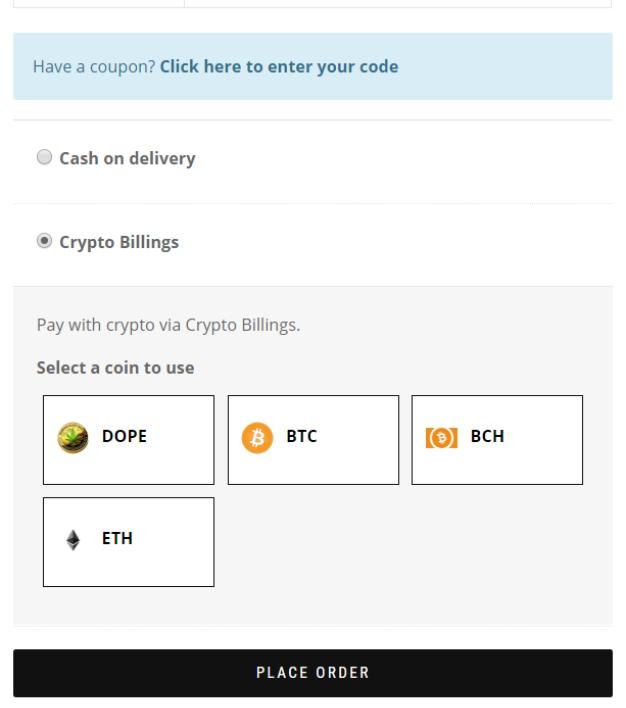

On the merchant's side there was not much to it. Install the plugin, paste in the API key from a Crypto Billings account, tick the coins you were willing to accept, and write the short instruction text customers would see. The plugin registered itself with WooCommerce as a payment method called Crypto Billings, next to whatever else the store already offered.
On the customer's side it looked like the screenshot. Pick a coin, place the order, and land on a hosted payment page showing the amount due in that coin and the merchant's own receiving address. When the payment confirmed, the WooCommerce order flipped to paid on its own.
How it worked
The whole design rested on one decision: price the order and track it, but let the money move wallet to wallet.
The merchant added the plugin to a WooCommerce store, pasted in their own wallet addresses for each coin, and switched on the ones they wanted to accept. Setup took minutes.
The customer chose Bitcoin, Ethereum, Bitcoin Cash or DopeCoin. Crypto Billings priced the cart at the live CoinMarketCap rate and showed the merchant's payment address with the exact amount due.
The customer paid directly to the merchant's address. Once the payment confirmed, the order was flagged as paid in WooCommerce and the merchant fulfilled it like any other sale.
This is the end of process_payment() from the plugin, version 1.1.0, in the public repository. It packages the items, billing and shipping details, signs the request with a key derived from the merchant's API key, order id, currency and total, calls createOrder(), and sends the customer to the returned payment page. Success, cancel and notify callbacks close the loop.
Stores outside WooCommerce used the same HTTP API directly. Third-party developers built their own client libraries against it. A community PHP package for Composer is still on GitHub.
// class-wc-cryptobillings-gateway.php, v1.1.0
// end of process_payment(), reformatted for width

$toCryptoCurrency = get_post_meta(
    $order_id, 'Coin Symbol', true
);

$encrypt_key = WC_Cryptobillings_API::create_encrypt_key(
    $this->api_key, $currency,
    $order->get_total(), $order_id
);

$gateway = $payment->createOrder(
    $currency, $order->get_total(),
    $toCryptoCurrency, $this->instructions,
    $this->successUrl, $this->cancelUrl,
    $this->notifyUrl, $order_id, $encrypt_key,
    $itemArray, $shipping, $billing, $shopInfo
);

if (!isset($gateway->result->redirect_url)) {
    wc_add_notice(
        'API Failure: ' . $gateway->error, 'error'
    );
    return array('result' => 'failure', ...);
}

return array(
    'result'   => 'success',
    'redirect' => $gateway->result->redirect_url
);
On the record
Everything here is independently checkable. The plugin, its source, its reviews and a third-party integration are all still public. The sources page has the full detail.
Timeline
One of the earliest cannabis cryptocurrencies and one of the earliest coins listed on CoinMarketCap. The problem Crypto Billings later worked on, how a merchant actually takes a coin like this, was his own problem first.
Built alongside the 2017 DopeCoin relaunch, at the top of that market cycle, to give online merchants a way to accept crypto without a custodian in the middle.
1.0.0 launches the gateway. 1.0.1 broadens coin support. 1.0.2 adds Bitcoin Cash. 1.1.0 brings compatibility up to WordPress 5.6 and WooCommerce 5.0. All four released under GPLv3 on the official directory.
"Fast, Easy, Safe & Free! 5 Star+" in February and "One stop crypto Plugin" in November. Both from merchants who ran it.
Crypto Billings stops onboarding merchants and processing checkouts. By then the mainstream processors had started accepting crypto themselves.
cryptobillings.com does not offer payment services. It documents the product as it operated, with links to the primary sources.

Founder
Adam Howell is a Canadian cryptocurrency founder based in Dubai who has been building in crypto since 2014. He created DopeCoin that year, one of the earliest meme coins and one of the earliest coins listed on CoinMarketCap.
Crypto Billings came out of the 2017 DopeCoin relaunch, in the same stretch that produced the ad exchange which became Grow Advertising. He went on to found SuperDoge, a charity token covered by Bloomberg and CNBC, and today builds Web3 infrastructure in Dubai. More about Adam Howell.
I started Crypto Billings in December 2017 because I had a coin and nowhere to spend it. DopeCoin had been around for almost four years by then and almost no online store could take it at checkout, or Bitcoin for that matter, without going through a processor that wanted custody of the money and a cut of it. That seemed backwards to me. The whole point of the thing was that you could pay someone directly.
So we built the gateway around one rule. We would price the order and tell the store when it was paid, and the coins would go straight from the buyer's wallet to the seller's. We never held a balance for anyone. We charged nothing, on either side, because a small shop trying crypto for the first time should not have to pay for the experiment.
It ran for five years. By January 2023 the big processors had come around to accepting crypto, which is roughly what I expected would happen, and I wound it down. This page is here so the record of what it was stays in one place.
Adam HowellFounder, Crypto Billings · Dubai